Good morning/afternoon/evening to all OGF administrators. Regardless of whether your country or region acknowledges the "Chinese Spring Festival," we extend our greetings to you: "Happy Year of the Snake!"
The motivation for this application stems from the following:
A significant number of new members have recently joined Huaxia, and the existing area can no longer meet the needs of some members.
Previously drawn content has been noted as being too close to the current borders of Huaxia, making its placement unreasonable. Adjustments or relocations are difficult and could result in a large amount of junk data.
The current boundaries in some areas are not conducive to designing appropriate terrain.
To facilitate better development of Huaxia, we hope to expand its territory moderately.
Based on prior consultations through internal messages, our primary direction for expansion is southward. However, to avoid the capital becoming excessively northern, we may also need to extend slightly northward. In the first section of this application, we will introduce the proposed expansion area and provide details by land block number. We are uncertain how much expansion will be approved, so the proposed range represents our most ideal scenario. If administrators find it excessive, we kindly request a partial reduction of land blocks as necessary.
The following sections will outline the expanded borders of Huaxia, its natural geography, human society, and other essential aspects required for this application.
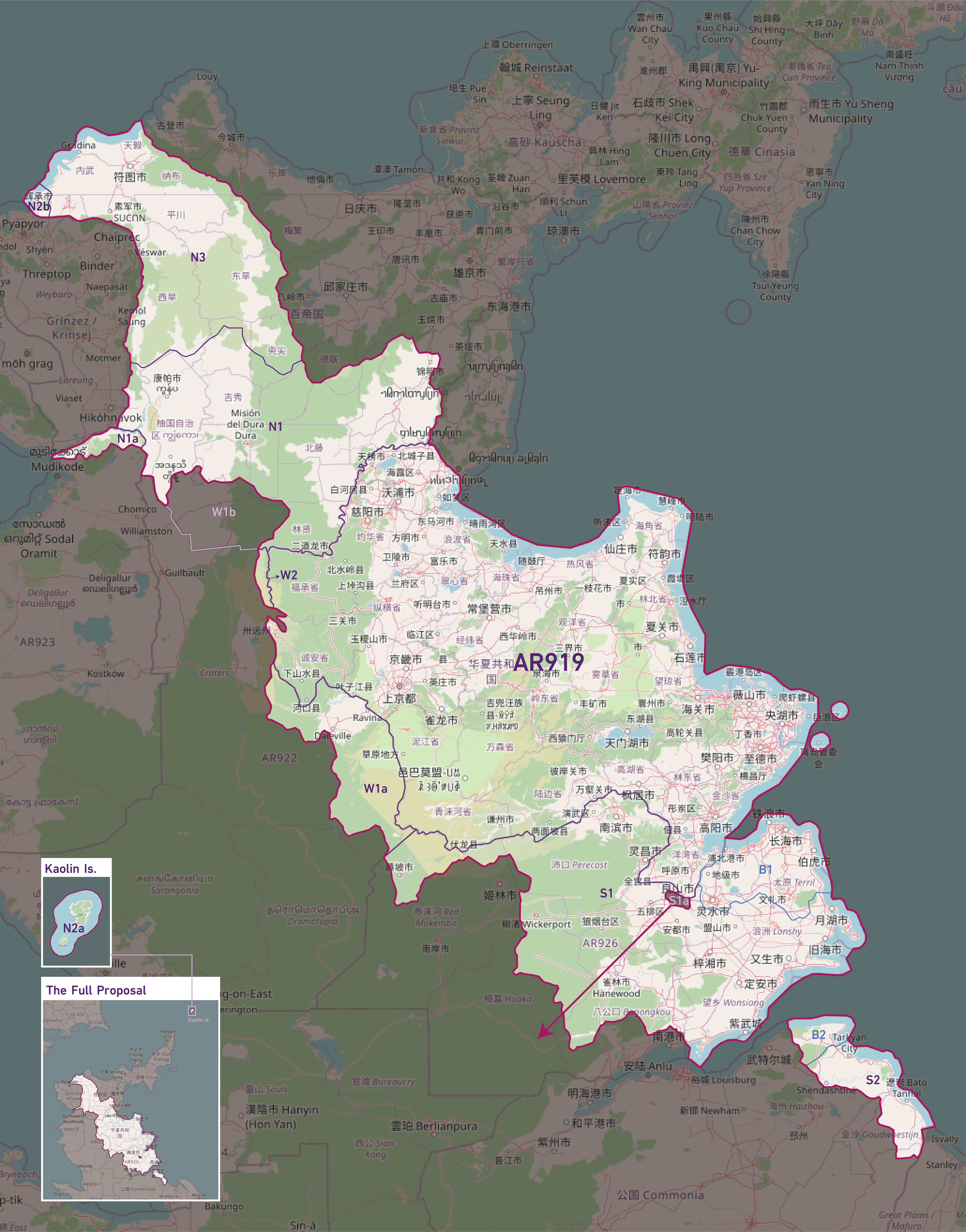
The planned expansion area is illustrated in the diagram below and includes the following:
Given the position of Huaxia's capital, we aim to expand both southward and northward to centralize the capital's location. The primary areas include:
Northern expansion: Southern part of Bai (N1), western part of Bai (N3), and a small northern portion of AR922 (N1a).
Southern expansion: Eastern part of AR926 (S1) and a small coastal portion of AR900 (S2).
In addition to the main land blocks mentioned above, there are smaller sections along the north-south axis (N2a, N2b) that we propose to designate as special administrative regions.
Additionally, to make the western depth of Shangjing (Shangjing) more reasonable, we wish to adjust the western boundary further by including two small portions of eastern AR922 (W1, W2). As compensation and in exchange for the additional AR922 territory gained in a previous boundary adjustment, we propose ceding the W1b portion of the original N1 block extending toward Bai. This portion can either be integrated into AR922 or considered for the establishment of a new nation.
Considering prior communication, where the user TGSpace declined the integration of Liangshan (良山) into Huaxia and noting the existing complete border facilities in that region, we propose leaving Liangshan area as an exclave of AR926 (S1a) rather than incorporating it into Huaxia.
Within the S1 and S2 blocks, we plan to designate B1 and B2 as internal blue territory within Huaxia to provide free and open mapping space for new collaborators and other contributors. These two areas are planned to be established as two separate provinces (provincial-level administrative divisions). The borders between these zones and the rest of Huaxia will be treated as provincial or regional boundaries. We will appropriately clean up and relocate some existing content within these blue teritories to free up space.
Due to our vision of having diverse coastlines in various regions and fostering boundary collaboration with neighboring nations (i.e., increasing the number of private neighboring areas), we hope to retain N1a, N2a, and N2b regardless of other adjustments, even if they must exist as exclaves.
自然地理 / Physical Geography
Physical geography
An overview of climate, topography and landscape of the country. With the exception of Beginner territories, you should always create a sketch map to illustrate & explain your plans. You can add a link to this (hosted on imgBB, Postimages or similar, but not imgur.com)
地形 / Terrain
北部 / Northern Expansion Area
北部的地理部分参考百帝国先前的计划,较为简单,如右图:
图中紫线为大致的国界。
红线为北塔洲(North Archanta)中央山脉(Central Mt. Range)的主分水岭,中央山脉在图中现有的「Misión del Dura Dura」地区会被开一个小口,形成一个关隘〔暂命名「通明关」(Tongmingguan),图中X所在〕,以便东西方向通行,此关隘以北的中央山脉会略微向西南延伸一些,以符合北塔洲北部山体整体呈现西南—东北走向的特点。
The northern terrain draws inspiration from the Bai Empire's previous plans and is relatively simple, as shown in the diagram:
The purple lines indicate the approximate national borders.
The red line represents the main watershed of the Central Mountain Range in North Archanta. In the existing "Misión del Dura Dura" area, a small pass will be created in the mountain range (tentatively named "Tongming Pass", or "通明关" in Renminyu, marked with an X on the diagram) to facilitate east-west passage. The Central Mountain Range north of the pass will slightly extend southwest to align with the overall southwest-northeast orientation of the northern mountains in North Archanta.
The light blue lines represent rivers, primarily two:
One originates in the current "Yangjian (央尖)" area and flows northward into the sea (tentatively named "Xin River", 莘河).
The other originates in the mountainous region south of the first river's basin and flows westward into the sea, serving as the boundary river between AR923 and Grinzez (tentatively named "Qiong River", 弶河).
The Xin River has a relatively small flow in the shrubland area west of the Central Mountain Range (tentatively named "Duiliyuan", 堆离原) but gains volume further north, forming a small delta on the northern coastline. The Qiong River, with a larger flow, supports the appearance of its western estuary.
The Dark blue spots indicate scattered hills or isolated mountains.
The Green circled areas represent larger, higher mountain ranges.
Climatically, the northwestern coast is planned to be subtropical and humid, while Duiliyuan will differ from Huaxia’s existing humid areas, being drier, possibly resembling grasslands or arid regions (but not deserts).
Additionally, we plan to add small islands along the northwestern coastline near the mountains in accordance with the Rules of the sea of OGF. The details will be drafted or directly drawn on the map after the application is approved.
The southern terrain is more complex and includes parts of the surrounding blue teritories, as shown in the diagram:
The purple lines indicate the approximate national borders.
The red line represents the main watershed of the Central Mountain Range in North Archanta.
The light blue lines represent several rivers, all originating from mountains or highlands with significant flow. However, since the southern coastal areas are predominantly mountainous, most river mouths (except for the one in eastern AR926 originating from the B2 blue teritory) will not form deltas.
Dark blue spots indicate scattered hills or isolated mountains, primarily distributed as transitions between larger green mountain ranges or along the coast.
Green circled areas represent larger, higher mountain ranges.
Yellow circled areas denote highlands or plateaus with relatively high altitudes but minimal elevation changes. There are two key highland areas:
The existing Minoa Grassland (米诺草原) (currently mostly within Huaxia), with an elevation of 700–800m. It is almost entirely flat, separated from the lower western and northern regions by steep slopes (similar to western Pakistan).
The Linzhou Highland (林州高原), which spans Huaxia, AR926, and AR924. This area has extensive rainforest coverage, but land near cities may be cleared for agriculture. Its elevation ranges from 500–1000m, with minor folds (small hills) transitioning smoothly to the lower terrain in the southeast. Toward the southern coast, the region features vast rainforests, while to the east, the coastal areas are primarily cultivated, without rainforests. The distribution of rainforests aligns with the current forested regions on the map.
And specially about S1 area: The eastern coastline where it does not connect with hills will resemble the mudflat coastline of Jiangsu, China, without sandy beaches.
Also, we plan to add small islands in the waters between Changhai (长海) and Richu Island (日出岛). The territorial waters in this region may be enclosed, drawing inspiration from the Bohai Sea in China.
In the future, the terrain across the Huaxia region will be primarily composed of plains, grasslands, and various types of forests, as depicted in the diagram. Specific areas include:
Uncolored areas (marked as "F"): These are plains, predominantly cultivated as farmland but also featuring conservation forests in certain areas. These plains will be the primary locations for cities, towns, and villages, serving as the population hubs and hosting over 75% of Huaxia's population.
Light green areas (marked as "G"): These represent grasslands, mainly distributed in the Minoa Grassland near Huaxia's capital and the Wucao Grassland in the mid-eastern region. These grasslands are mostly designated as protected areas and have relatively low population densities.
Grass-green areas (marked as "M"): These indicate mountain forests, found along the Dahua Ridge, the Central Mountain Range of North Archanta, and the eastern coastal regions. Populations in these areas are primarily concentrated in the river valleys of the mountains.
Dark green areas (marked as "R"): These are rainforests, primarily located in the southern region and the southwestern area near Shangjing. These areas are humid and mostly flat, with sparse populations. The ecological integrity of these rainforests will remain intact as they are under protection. A few forested counties will be designated as population centers.
Bright yellow areas (marked as "S"): These represent transitional regions between deserts and sandy terrain, primarily in the Duiliyuan area.
Orange areas (marked as "H"): These are high-altitude forests, mainly distributed in regions above 2,000m in the Central Mountain Range of North Archanta.
The landform design
人文地理 / Human Geography
Human geography
A brief description of the territory demographics, economic development, land occupation, infrastructure and mapping style
Overall, the expanded Huaxia region continues to follow the previously proposed economic plan, where economic development faces significant regional disparities. The coastal areas and regions alongFanhua River (繁花江) are economically advanced, hosting Huaxia's main metropolitan areas with high population density and thriving new industries. These regions mirror the current situation in modern China. Other regions have generally lower economic levels, focusing primarily on agriculture and industry (especially heavy industry). Cities are small—most prefecture-level city centers are only slightly larger than county-level centers in early-2000s China.
In contrast to the earlier plan (with agriculture dominant west of the Greater Hua Ridge, 大华岭 and industry to the east), the expanded region includes larger cultivation zones to meet population and food demand. The eastern areas will also feature agricultural and forestry industries, though due to geographic and climatic limitations, these industries may not dominate local economies. More, Advanced economic regions will increasingly influence less developed ones through policy-driven integration. Transport networks radiating from urban centers will ensure better inter-regional connections, replacing the earlier model of focusing solely on intra-metropolitan transportation.
产业 / Industries
北部区域
除沿海地区以及现状图上标注为「柚国自治区」(Kyawal-kaw Autonomous Region)的地方以外经济较差,以农牧业为主(中央山脉通明关以南的山区还会有林业),不会有太大的城市,不敌华夏现有的地区,但会随着时间有所改善,如华夏中央会尝试在堆离原部分地区开辟工业区(主要为食品加工行业等轻污染或无污染产业)、边疆生产建设兵团(Border Production and Construction Corps, BJBT)会改善农业;
Non-coastal and mountainous areas (excluding Kyawal-kaw Autonomous Region, 柚国自治区): These regions remain underdeveloped, primarily focusing on agriculture and animal husbandry, with forestry in the mountainous areas south of Tongming Pass in the Central Mountain Range. Large cities will not develop here, but conditions will improve gradually. The government plans to establish industrial zones in parts of Duiliyuan, focusing on low-pollution industries (e.g., food processing), while the Border Production and Construction Corps (BJBT) will work on improving agricultural practices.
Coastal areas: These regions benefit from strong industrial bases due to convenient transportation. Large cities will emerge, though industrial pollution remains an issue. The government will enforce industrial relocation or green transformations without undermining the region's industrial strength.
Kyawal-kaw Autonomous Region (to be renamed Yuzu Ethnic Dao): As an ethnic autonomous region, it will receive central government support. Besides agriculture and forestry, its scenic landscapes and international transport routes will foster a well-developed tourism and logistics industry. The planned canal connecting Myahoetkyee (大城 ံယဟောဧတ္က္ယေဧ) to Duradura Dam will further boost its logistics capabilities, enabling it to serve as a central hub for cargo transshipment between Huaxia and neighboring regions.
Economically, this region is centered on Gaoyang (高阳), already part of Huaxia. Economic development diminishes the farther one moves from Gaoyang, especially in the Linzhou Highland due to its geographical isolation. Coastal areas in S1 have ports, leading to moderate economic activity. However, these areas remain less prosperous than Huaxia's core coastal regions.
Agriculture and industry dominate here. The agricultural model, including crop types and yields, takes inspiration from modern Indonesia but with more concentrated farmland. Plantation crops will also gain emphasis.
Industrial activities will focus on coastal areas (including S1's eastern coast) and feature heavy industries with some pollution. Light industries will be scattered near cities in the Linzhou Highland.
交通 / Transportation
公路 我们计划扩展我们的干线高速路网。北部主要计划是(1)将现有的上京(Shangjing)—阳东(Yangdong)高速公路(GJ1 京边高速)从慈阳(Ciyang)以西的东虹(Donghong)附近断开,以北的部分改线,西向北跨过同胞大江(Tongbao River),从通明关穿越中央山脉到达柚国自治区东界附近,再向北沿堆离原中部穿越之,抵达符图(Futu)并向北延伸至海岸,作为西百地区(West Bai Region)的南北干线,并辅以东西向的支线高速;(2)向北沿伸现有的上京—三江(Sanjiang)高速公路(GJ2 京三高速),过河接入现有的百国的高速至边界,作为百南部中央山脉以东的南北干线,并辅以东西向的支线高速。南部主要计划是(3)南延央湖(Yanghu)—石布石(Shybshi)高速公路(GY7 东南沿海高速)经茂桑(Maosang)、梓湘(Zixiang)、文屋(Wenwu)到达自由港(Ziyougang),作为南部的南北干线,辅以连接雀林(Quelin)、又生(Yoso)的支线;(4)从裁雨山(Caiyushan)至自由港沿海设置一条干线高速公路;(5)自林州高原东部的烟狼台(Langyantai)向东经石不石、灵水(Lingshui)、文礼(Wenli)至月湖(Yuehu)设置一条东西向干线高速公路。
Railways For Northern Expansion Area, two main north-south railways will traverse this area, with east-west connections near the coast and Tongming Pass, extending into Bai Nation and Greenzeth (pending agreement). A high-speed rail line from Ciyang, roughly following the expressway route, will also be constructed. For Southern Expansion Area, a dense railway network will follow highway alignments, with main lines connecting economic hubs.
Airports For Northern Expansion Area, a major international airport will be built in Futu, with a smaller international airport for tourism in the Kyawal-kaw Autonomous Region. Other areas will feature small domestic airports. For Southern Expansion Area, each provincial capital, Dao administrative center, and special administrative zone will have international airports, including one particularly large airport on the southern coast of S1.
Water Transport For Northern Expansion Area, a large port and a medium-sized port will be constructed on the northwestern coast for trade. The Jiang River's middle and upper reaches will be upgraded for navigation, complemented by a new canal connecting Myahoetkyee and Duradura Dam, which will include a dam and ship lock at its southern end for transnational river access, whose size can be refer to Funan Techo Canal. For Southern Expansion Area, despite abundant rivers, inland waterways will play a minor role due to the prevalence of other transport modes. Coastal ports will handle most maritime logistics.
经济有关的未提及的其他方面如教育、体育等未尽事宜,遵从现有华夏的一般性计划,参见我们的合作页面。
Other aspects related to the economy, such as education and sports, will follow Huaxia's general development plans. Further details can be found on our collaboration page.
Previously, we planned for Huaxia to have a population of 500 million. However, as Huaxia was only 1.8 times the size of present-day Sichuan Province in China (which has a relatively high population density, with a population of 83,674,866 according to China's 2020 Seventh National Census[1]), it could not accommodate 500 million people. With the expansion of territory, the total area can now support a population of this scale. Thus, the total population target remains unchanged. The pre-expansion core area is planned to accommodate 230 million people, the southern expansion area 160 million people, and the northern expansion area 110 million people, primarily distributed in the previously mentioned plains regions.
Although the total population density of Huaxia after expansion will still exceed that of present-day Sichuan Province, it is reasonable considering that cities and towns in Huaxia are smaller but more densely distributed than in present-day China (due to the earlier plan that “all administrative regions in Huaxia are scaled-down versions of their real-world Chinese counterparts”). This higher density aligns with the unique administrative and urban planning structure of Huaxia. Additionally, population considerations will influence the size of urban areas, and in line with the proposed “county-merging and city-consolidation” plan, we will appropriately relax restrictions on the size of built-up urban areas.
Due to the previous size limitations of Huaxia, counties (ting), cities, and other administrative divisions were generally small[2]. After the expansion, if the existing sizes of counties and cities are maintained, it may result in an excessive number of administrative divisions. To address this, adjustments to the current administrative structure are planned:
New Levels of Divisions: We propose the establishment of new levels of divisions, such as dao, lu, and fu, and adjustments to certain provincial (lu) boundaries in areas where delineation is challenging.
County-Merging and City-Consolidation: We plan to merge some counties and cities, aiming for a total of around 400 cities and 3,800–4,300 counties (ting) across Huaxia. The number of provinces (lu) is expected to reach around 35.
We have internally developed draft principles and preliminary plans for county-merging and city-consolidation, along with some delineations of provinces, cities, and counties. However, due to space limitations, the details cannot be included here. We appreciate your understanding.
人文地理 / Human Geography
History & culture
A brief description of the intended culture and language
In terms of history, the Southern Expansion Area will be set as historically under the influence of the Jiangzhu Dynasty (江诸, referring to successive regimes along the Hua River, equivalent to the Central Plains dynasties in the real world). This region once contained several tributary states, some of which were annexed by the Jiangzhu Dynasty. The current territory (referring to the expanded area) first formed during Huaxia’s unification in AD 150–180, experiencing cycles of division and reunification. It was unified again approximately 600 years ago, after which Jiangzhu strengthened its governance over the southern region, leading to stabilized borders.
For Northern Expansion Area, in October 2024, during leisure discussions, we drafted a preliminary plan to address historical inconsistencies between the Bai Empire (百帝国) and Huaxia, based on leftover information from the Bai Empire's wiki page and some of our ideas. (See the Huaxia Wiki page for details.) At that time, due to Zhenkang’s withdrawal, we were unable to consult his opinion. Building on that discussion, we extend the narrative as follows:
The Bai Empire, due to political and systemic issues following a postwar decline, gradually weakened. Uprisings and civil unrest emerged, with rebels aligning with local minority groups in the Duili region (堆离, an area with many minority populations), ultimately seizing significant territories (the areas we aim to include in the expansion). Negotiations ensued between the rebels and the government, leading to a settlement that granted independence to rebel-controlled lands. The government in the original eastern territory underwent restructuring. However, the newly independent region, hindered by poor natural conditions, failed to achieve substantial development. Meanwhile, the southern region (Huaxia) grew stronger after overcoming economic setbacks. Eventually, through referendums involving the local populations of various ethnic groups, the region voted to join Huaxia within a few years.
In terms of culture, the Southern Expansion Area mostly follows the existing plan. Originally, a vast rainforested area separated the southern region from the central regions of the Xia Empire. It was home to several different ethnic groups. After the current borders of the Xia Empire were established, the dominant ethnic group in the empire, the Xing (兴) people, assimilated parts of the local populations. They absorbed some customs of the local people, but the region retained its own traditions. The culture of this region is distinct from the "northern China" culture of the present-day Xia Empire. It is closer to the culture of southern China, referencing areas like Xiang-E (湘鄂), Min-Nan (闽南), and Yue-Guang (粤广). The population is primarily Han, but there are noticeable cultural differences from the northern Han culture. There may also be a blend of Southwestern Chinese ethnic cultures, as Southwestern China is home to many ethnic minorities with rich cultural traditions. This combination of influences reflects the area's diverse ethnic composition. The Southwestern cultural traits would primarily be applied to the northern regions, as explained below.
In the Northern Expansion Area, the western part of the expanded area beyond the central mountain range and some of the areas extending westward are geographically isolated by large mountain ranges. Therefore, these areas have a distinct cultural identity from the Jiangzhu region. The plan is to draw inspiration from Southwestern Chinese culture, which could be reflected in the design of villages, terraced fields, and place names with a Southwestern flavor. Additionally, based on the AR923 language, we believe it is suitable to use some of the minority languages from Southwestern China in the northern region (some Southwestern languages are similar to Thai and Burmese). We plan to incorporate this by using word combinations for place names.
As for the southeastern part of the northern region (the southeastern part of the Bai Empire), due to its geographical proximity, its culture aligns with the current Xia culture. However, considering that this area was once under the control of the Bai Empire (prior to the early 14th century, as detailed on our Wikipedia page), the culture here has been more influenced by the West (colonial influences). We envision the culture of this area being similar to that of Singapore[3]. This may be reflected in the style of older districts in cities, where private residences might be present, but in newly constructed districts, particularly those built in the past 20-30 years, the style will remain modern, in line with current Chinese trends.
脚注 / Notefoot
Past mapping
To support your request provide links to areas of OGF mapping which showcase your mapping skill. Mapping relevant to the requested theme & geography is especially useful.
The {{coord}}, {{node}}, {{relation}} or {{scalehelper}} templates can optionally be used to link to the OGF map - they result in nicely formatted links. Or you can paste in a URL.
下面给出了华夏合作项目参与者的各种过往绘图。
Below are a variety of past drawings of the participants in the Huaxia cooperation project.
↑ 2.02.1现实中国的地级市的辖区面积的中位数约为12000平方千米,而目前华夏的约为3000平方千米。
In reality, the median area of prefecture-level cities in China is about 12,000 square kilometers, compared to about 3,000 square kilometers in Huaxia.
↑ 3.03.1打个不严肃、非常局限的比方,如果你玩《崩坏:星穹铁道》这款游戏,那么这两个文化的区别将会是其中仙舟罗浮和仙舟朱明之间的文化差别。A lighthearted and limited analogy: if you have played the game Honkai: Star Rail, the cultural difference between these two areas can be likened to that between Xianzhou Luofu and Xianzhou Zhumin.